Key takeaway: not all collagens have the same function. Type I collagen primarily acts on skin firmness, type III on its elasticity, while type II supports joints. Understanding their differences allows for choosing a formula truly adapted to one's needs and a global longevity approach.
Not all collagens are created equal. Type I collagen works on skin firmness, type III on its elasticity, while type II supports joints.
Understanding them well helps choose a truly effective collagen, adapted to one's needs and lifestyle.
Collagen is everywhere today: in food supplements, beauty routines, collagen masks, and marine collagen powders.
Yet, one question often arises: which collagen to choose?
Behind this generic term lie several types of collagen, with very different roles. And it is precisely this difference that influences the actual effectiveness of a product.
Summary
- Understanding collagen to choose it better
- Type I Collagen: The Key to Firm, Dense Skin
- Type III Collagen: Skin Elasticity and Radiance
- Type II Collagen: The Pillar of Joint Comfort
- Should you choose only one type of collagen?
- The Demain Beauty approach: a more global vision of collagen
- How to choose your collagen well?
Understanding collagen to choose it better
An essential protein at the heart of the skin
Collagen is a protein naturally produced by the body. It represents about 30% of the body's proteins and plays a fundamental role in tissue structure.
From the age of 25, its production gradually decreases.
Result:
- loss of firmness
- appearance of wrinkles
- thinner skin
- joint discomfort
- muscle loss
This natural decline explains why supplements based on marine collagen peptides are so sought after today.
Marine collagen: why is it preferred?
Marine collagen is now one of the most used in food supplements dedicated to the skin.
It is particularly appreciated for:
- its high bioavailability
- its richness in type I collagen
- its structure similar to human collagen
It is also found in the majority of "beauty" formulas, particularly in powder or stick form to be diluted.
Type I Collagen: The Key to Firm, Dense Skin
Type I collagen is the most abundant in the human body.
Its main role
It acts directly on:
- skin firmness
- dermal density
- wrinkle resistance
It is found mainly in skin, bones and tendons.
It is the essential collagen to support smoother, denser and more toned skin over time.
Type III Collagen: Skin Elasticity and Radiance
Often less known, type III collagen nevertheless plays an essential role in the visual quality of the skin.
Why it is essential
It acts in synergy with type I collagen and provides:
- elasticity
- suppleness
- bouncing effect
Very present in young skin, it gradually decreases with age, contributing to the appearance of sagging skin and a less luminous complexion.
Combining type I and III collagen therefore allows for a more complete action on the overall quality of the skin.
Type II Collagen: The Pillar of Joint Comfort
Type II collagen is mainly present in the joints and cartilage.
Its benefits
- cartilage support
- better mobility
- shock absorption
Unlike types I and III, it does not directly target the skin, but fits perfectly into a global well-being and longevity approach.
Should you choose only one type of collagen?
This is where everything changes.
A comprehensive approach is more effective
Each type of collagen meets a specific need:
- Type I → firmness and structure
- Type III → elasticity and radiance
- Type II → joint comfort
Combining them allows for simultaneous action on:
- the skin
- overall well-being
- aging prevention
This logic guides today's most advanced formulas.
The Demain Beauty approach: a more global vision of collagen
Today, the trend is evolving. It's no longer just about consuming collagen, but about optimizing its effectiveness in the body.
An Inside/Out approach
Demain Beauty skincare products are part of a global approach:
- acting from the inside and outside
- supporting the microbiome
- optimizing the assimilation of active ingredients
Two targeted supplements for specific needs
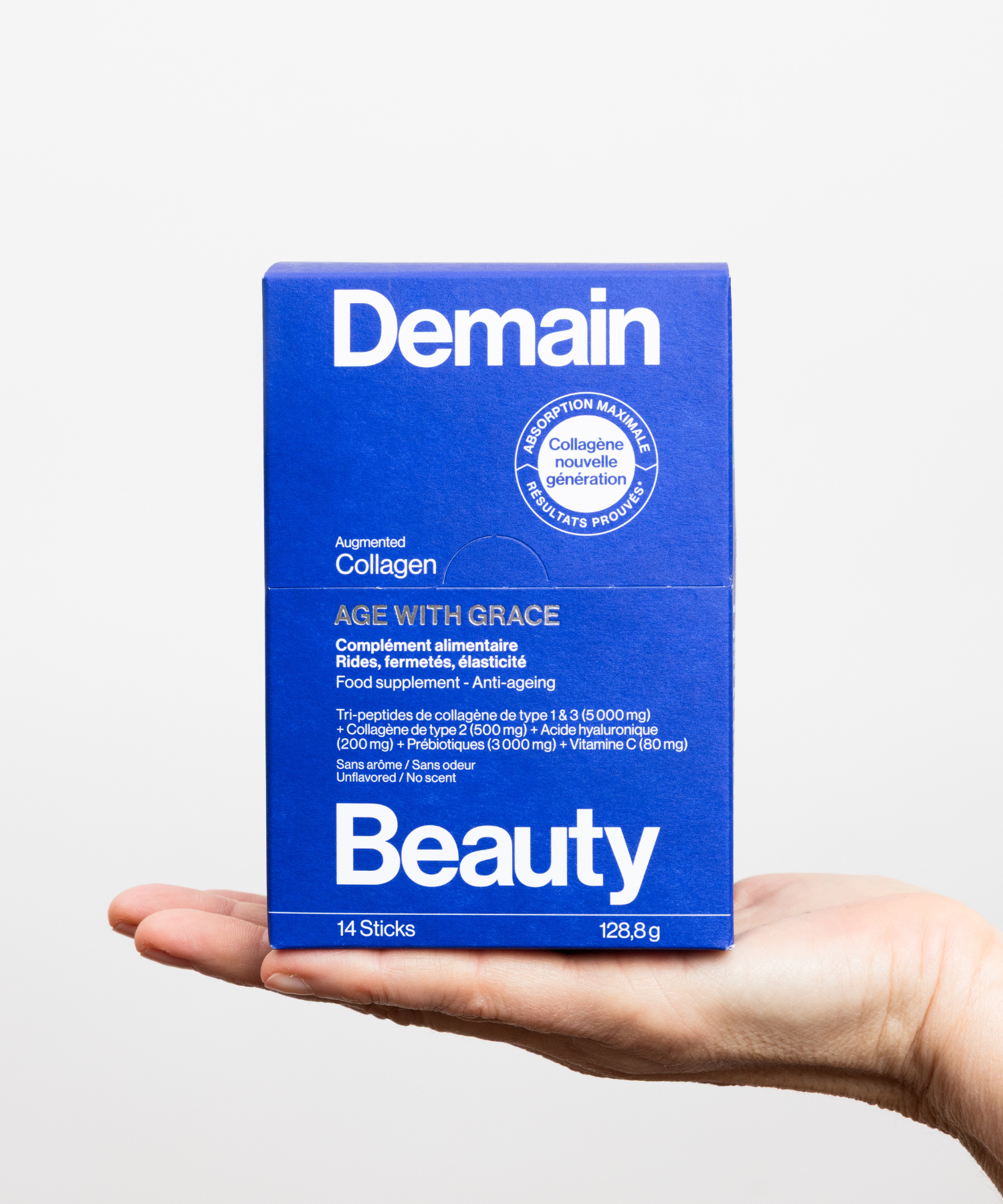
Age With Grace – Demain Beauty Food Supplement
- Hydrolyzed marine collagen type I (9500 mg)
- Type II collagen
- Hyaluronic acid
- Vitamin C
- Prebiotic (inulin)
A complete formula for:
- skin firmness
- skin density
- joint comfort
- a global longevity approach
Drink & Glow – Radiance collagen supplement
Designed to:
- boost skin radiance
- improve complexion quality
- support hydration
These two supplements allow you to adapt your collagen intake according to your goals: immediate radiance or global anti-aging and well-being action.
How to choose your collagen well?
Here are the essential criteria to remember:
| Criterion | Why? | To look for |
|---|---|---|
| Marine collagen | Better absorption | Hydrolyzed marine collagen |
| Collagen peptides | Optimal assimilation | “Peptides” or “hydrolyzed” |
| Enriched formula | Enhanced action | Vitamin C, hyaluronic acid… |
| Global approach | Acts on the whole body | Skin, hair, joints |
| Real needs | Avoid the trend effect | Formula adapted to the objective |
FAQ
What is the difference between type 1, 2 and 3 collagen?
Type I collagen primarily acts on skin firmness and structure, type III on its elasticity and radiance, while type II is mainly present in joints and cartilage. Each type therefore has a specific role in the body.
Which collagen to choose to improve skin?
For the skin, the most interesting collagens are type I and type III. Type I helps improve skin firmness and density, while type III supports skin elasticity and suppleness.
Can you take several types of collagen at the same time?
Yes, it is entirely possible to combine several types of collagen. In reality, formulas combining types I, II and III are often preferred for a more global action on the skin, joints and general well-being.
How long does it take to see the effects of collagen?
The first effects can appear after 3 to 8 weeks of regular use, depending on the individual, lifestyle and the quality of the collagen consumed. Daily intake is essential for visible results.
Is marine collagen really more effective?
Marine collagen is often preferred because it is rich in type I collagen and has good bioavailability, which means it is easily assimilated by the body.
Does collagen have side effects?
Collagen is generally well tolerated when it is of good quality. Side effects are rare and mainly concern low-quality or poorly purified products. It is important to choose traceable and controlled supplements.